
Introduction
Delhi-NCR’s air quality turned ‘very poor’ for the first time this season on 2 November 2026, when the AQI touched 324 and CAQM invoked GRAP Stage II across the region. Stage I had already been in force since 21 October. For businesses, dust control in commercial spaces is now a daily priority, not a seasonal inconvenience.
If you manage an office, showroom, warehouse, hospital, school, or retail store in Delhi, Gurugram, Noida, Ghaziabad, or Faridabad, you have likely noticed dust settling on desks within hours of cleaning, air conditioners clogging faster, and employees complaining of sneezing, dry throat, and watery eyes.
Dust control in commercial spaces is no longer just about appearance. It affects employee health, productivity, equipment life, customer perception, and even compliance with workplace safety standards.
In this guide, the Glowster team shares 7 proven winter tips to keep your commercial space cleaner, healthier, and more professional, even in the toughest NCR winter.

Why Dust Control in Commercial Spaces Is Harder in Delhi NCR Winters
Before solving the problem, it helps to understand the cause. Several factors combine in winter:
- Temperature inversion: Cold air near the ground traps pollutants and dust close to the surface instead of letting them disperse.
- Low wind speed: Dust and fine particles (PM2.5 and PM10) stay suspended in the air for longer.
- Construction and road dust: Ongoing construction across NCR adds to particulate matter, although restrictions often apply under the Graded Response Action Plan (GRAP) when air quality worsens.
- Crop residue burning and vehicle emissions: These add to the overall pollution load during the season.
- Closed buildings: In winter, people keep doors and windows shut and run heaters, so indoor dust and allergens get recirculated.
The result is that indoor air quality in offices and commercial buildings can suffer, even when the space looks clean.
GRAP-2 Is Now On: What It Means for Offices, Showrooms and Warehouses
CAQM has directed the NCR states’ pollution control boards and the Delhi Pollution Control Committee to strictly implement all Stage II actions on top of Stage I. Vehicle curbs have also tightened since 1 November, with only EV, CNG and BS-VI diesel buses allowed in and others diverted at the borders.
The practical takeaway for facility managers: outdoor air will stay poor for weeks, so your indoor dust control plan has to start now, not in December. GRAP measures change with the AQI, so check the official CAQM website for the current list of restrictions.
Tip 1: Upgrade to HEPA-Grade Air Filtration
Standard filters in many HVAC systems and air conditioners only capture larger particles. Fine dust easily passes through.
What to do:
- Use HEPA air purifiers in high-footfall areas such as reception, conference rooms, and open workspaces.
- Check that your HVAC system uses filters with a suitable MERV rating for your building type.
- Size purifiers according to room area. An undersized purifier in a large hall will not make a real difference.
- Replace or clean filters on a fixed schedule. A clogged filter performs poorly and can even add to the problem.
Pro tip: Place purifiers away from walls and corners so airflow is not blocked.
Tip 2: Create a Strong Entrance Barrier
A large share of dust enters a building on shoes, clothes, bags, and trolleys. Stopping it at the entrance is one of the most cost-effective dust control measures.
What to do:
- Install heavy-duty entrance mats (both outside and inside the main door) to trap dirt and moisture.
- Use mats at least a few steps long so that people wipe their feet properly.
- Vacuum or shake out mats daily, and wash them regularly.
- Keep main doors closed and use air curtains where footfall is high.
Tip 3: Switch from Dry Sweeping to Damp Mopping and Vacuuming
Dry sweeping and dry dusting simply push dust into the air, where it settles again within hours. This is one of the most common mistakes in commercial housekeeping.
What to do:
- Use microfiber cloths and mops. They trap dust instead of spreading it.
- Prefer damp mopping for hard floors such as tiles, marble, and vinyl, with a suitable commercial floor cleaner.
- Use vacuum cleaners with HEPA filters for carpets, upholstery, and fabric partitions.
- Clean from top to bottom: first ceiling vents, light fittings, and shelves, then desks, and finally floors.
Tip 4: Maintain AC Ducts, Vents, and HVAC Systems
In winter, many offices use heaters and blowers. Dust that has gathered inside ducts and vents all year gets pushed straight into the workspace.
What to do:
- Schedule professional duct cleaning at least once or twice a year, ideally before winter begins.
- Clean return-air grills and supply vents monthly.
- Inspect the AHU (Air Handling Unit) and fan coil units for dust build-up.
- Seal gaps around windows, doors, and cable openings to reduce dust infiltration.
Regular HVAC maintenance also improves energy efficiency and extends equipment life, which saves money in the long run.
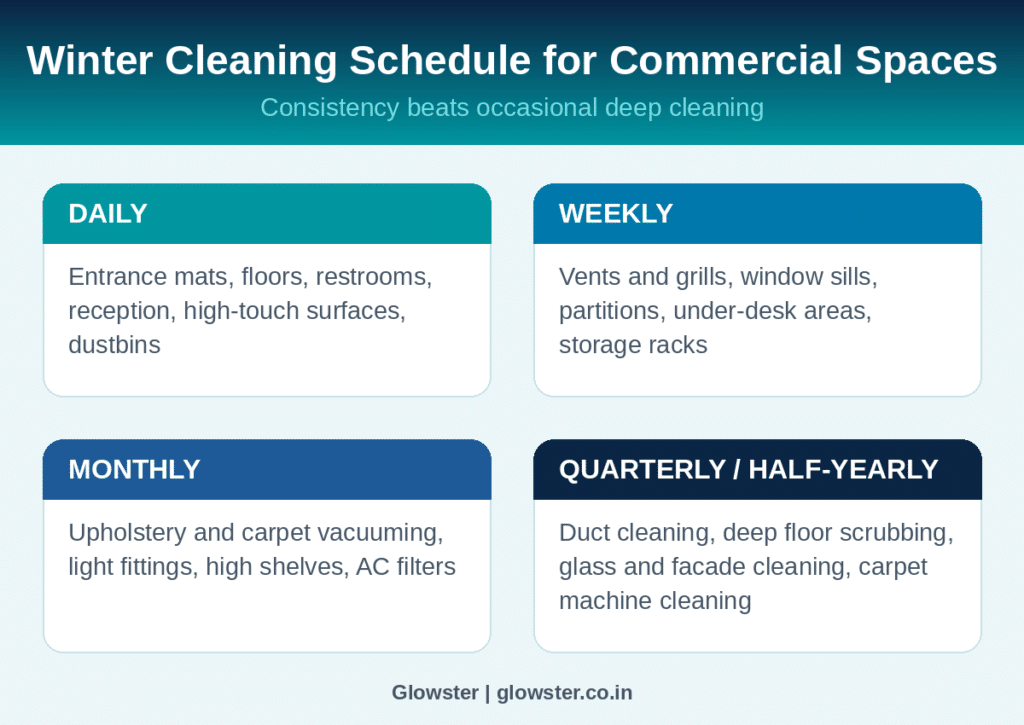
Tip 5: Follow a Fixed Winter Cleaning Schedule
Consistency matters more than occasional deep cleaning. A written schedule ensures nothing is missed, especially in large facilities.
A sample schedule you can adapt:
- Daily: Entrance mats, floors, restrooms, reception, high-touch surfaces, dustbins.
- Weekly: Vents and grills, window sills, partitions, under-desk areas, storage racks.
- Monthly: Upholstery and carpet deep vacuuming, light fittings, high shelves, AC filters.
- Quarterly or Half-Yearly: Duct cleaning, deep floor scrubbing and polishing, facade or glass cleaning, machine-based carpet cleaning.
Assign responsibilities clearly and keep a checklist or log so that quality can be verified.
Tip 6: Manage Humidity and Indoor Conditions
Winter air in NCR is often dry, which makes dust lighter and easier to stay airborne. At the same time, too much humidity can cause mould.
What to do:
- Aim for a comfortable indoor humidity range, commonly around 40 to 60 percent.
- Use humidifiers or dehumidifiers where required, and keep them clean.
- Add indoor plants such as snake plant or peace lily if you like, but treat them as a supplement, not a replacement for proper filtration.
- Fix leaks and damp patches quickly to avoid mould and mildew.
Tip 7: Use the Right Commercial Cleaning Products, and Stock Up Early
Good habits only work if your housekeeping team has the right products on hand. In winter, floors, glass and washrooms need cleaning more often, and running out of stock mid-season disrupts the whole schedule.
What to keep in stock:
- Floor cleaner for daily damp mopping, such as the Glowster GFC-02 Floor Cleaner
- Glass cleaner for windows, partitions and reception glass, such as the GGC-03 Glass Cleaner
- Disinfectant for floors and washrooms, such as GWP-06 White Phenyl
- Hand hygiene for staff and visitors, such as the GHW-01 Commercial Handwash
- Washroom cleaner for high-traffic restrooms, such as the GTC-04 Toilet Cleaner
For large facilities, ordering in bulk helps you avoid shortages. Glowster supplies commercial cleaning products in Noida, Greater Noida and Ghaziabad for offices, hotels, hospitals, warehouses and factories, with bulk orders and GST invoice available.
Browse the Glowster shop or contact Glowster for a bulk quote.
Quick Checklist: Quick Checklist: Dust Control in Commercial Spaces
- HEPA purifiers installed and filters replaced on time
- Entrance mats in place and cleaned daily
- Microfiber and damp mopping adopted
- Ducts, vents, and AHUs serviced before winter
- Written cleaning schedule followed with logs
- Humidity checked and controlled
- Cleaning and hygiene products stocked for the season
Benefits of Effective Dust Control
- Healthier employees: Fewer allergy and respiratory irritation complaints, which can mean fewer sick days.
- Better productivity: A clean and fresh workplace helps people focus.
- Longer equipment life: Computers, servers, printers, and machinery perform better with less dust.
- Stronger brand image: Customers and visitors judge your business by how clean it feels.
- Lower maintenance cost: Clean filters and systems use less energy and need fewer repairs.
Frequently Asked Questions
How often should a commercial office be cleaned in winter in Delhi NCR?
High-touch areas and floors should be cleaned daily. Vents, partitions, and upholstery need weekly or monthly attention, while duct cleaning and deep cleaning are typically done once or twice a year.
Do air purifiers really help with dust in offices?
Yes, when the right size and type is used. HEPA purifiers capture fine particles, but they work best alongside good cleaning practices and proper ventilation management.
Why does dust return so quickly after cleaning in winter?
Low wind, closed buildings, and high outdoor particulate levels mean fine dust keeps entering and resettling. Entrance control, damp cleaning, and filtration reduce this.
Is dry dusting bad for commercial spaces?
Dry dusting mostly moves dust from one surface to the air and back again. Microfiber cloths and damp methods are more effective.
Conclusion
Winter in Delhi NCR brings dust and pollution challenges that no business can ignore. The good news is that a structured approach works: strong entrance control, HEPA filtration, damp and microfiber cleaning, HVAC maintenance, a fixed schedule, humidity management, and the right cleaning products on hand.
Start small, stay consistent, and review your approach every season. A cleaner workspace is a healthier and more productive one.
Need cleaning and hygiene products for your office, showroom or facility this winter? Contact Glowster or visit the shop for bulk supply.
Disclaimer: This article is for general information only. Air quality conditions and regulations such as GRAP measures change from time to time. Please refer to official sources like CPCB and CAQM for current guidelines.