
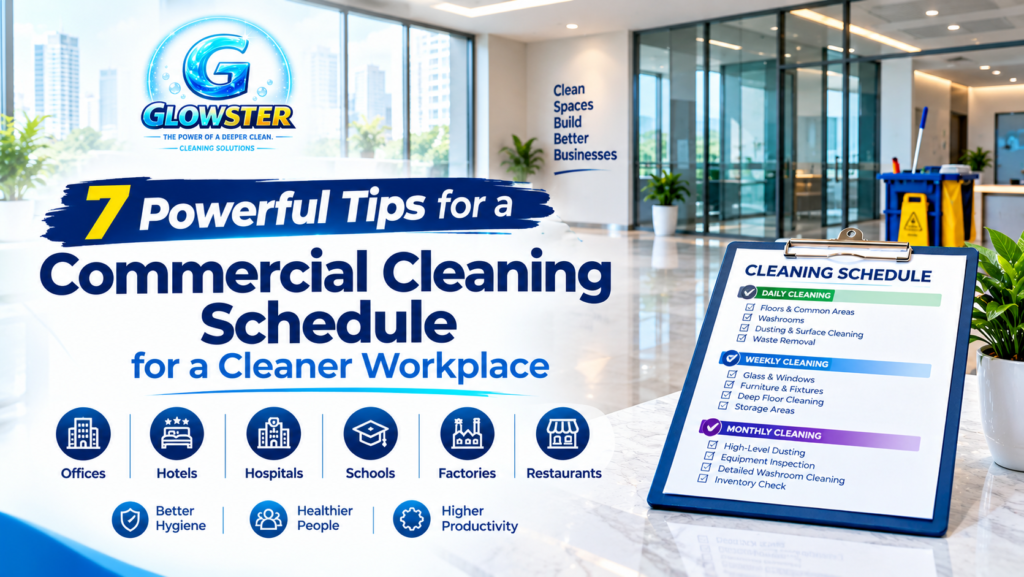
A clean commercial facility does not happen by chance. Offices, hotels, hospitals, schools, factories, warehouses and restaurants all need a structured Commercial Cleaning Schedule Tips to maintain consistent hygiene throughout the day.
Without a proper schedule, some areas may be cleaned too often while important high-traffic areas can be missed. A professional cleaning schedule helps facility managers define what needs to be cleaned, how often it should be cleaned, which cleaning products should be used and who is responsible for each task.
A well-planned commercial cleaning checklist can make housekeeping operations easier to manage, monitor and improve. Commercial Cleaning Schedule Tips
The Centers for Disease Control and Prevention (CDC) recommends regular cleaning of frequently touched surfaces and explains that cleaning generally comes before sanitizing or disinfecting in facility environments.
This guide explains how to create a practical daily, weekly and monthly commercial cleaning schedule for different types of commercial facilities. commercial cleaning schedule
What Is a Commercial Cleaning Schedule?
A commercial cleaning schedule is a structured plan that defines:
- Cleaning areas
- Cleaning tasks
- Cleaning frequency
- Cleaning methods
- Cleaning products required
- Responsible housekeeping staff
- Inspection requirements
- Completion status
A basic commercial cleaning schedule can be divided into:
Daily Cleaning → Weekly Cleaning → Monthly Cleaning → Periodic Deep Cleaning
For larger facilities, the schedule can also include shift-wise cleaning, high-touch surface cleaning, emergency cleaning and supervisor inspections.
A good schedule should be practical and easy for housekeeping staff to follow. Commercial Cleaning Schedule Tips
Why Is a Commercial Cleaning Schedule Important?
A professional cleaning schedule helps businesses maintain consistent hygiene across different areas and shifts.
1. Maintains Consistent Workplace Hygiene
Daily cleaning helps prevent dust, dirt, stains, waste and unpleasant odours from accumulating in frequently used areas.
2. Helps Manage High-Traffic Areas
Reception areas, corridors, washrooms, elevators, entrances and cafeterias generally require more frequent cleaning than low-traffic areas.
The CDC recommends regularly cleaning high-touch surfaces such as door handles, counters, elevator buttons, touchpads, restroom fixtures and other frequently touched surfaces.
3. Improves Housekeeping Accountability
When every cleaning task has an assigned employee or team, supervisors can easily check whether the work has been completed.
4. Helps Control Cleaning Costs
A structured schedule can reduce unnecessary chemical usage, repeated work and missed cleaning tasks.
5. Supports Professional Facility Management
Facility managers can use checklists, inspection records and cleaning schedules to monitor housekeeping performance.
7 Powerful Commercial Cleaning Schedule Tips
1. Divide the Facility Into Cleaning Zones
The first step in creating a professional facility cleaning schedule is dividing the workplace into specific cleaning zones.
Common cleaning zones include:
- Reception
- Workstations
- Meeting rooms
- Corridors
- Staircases
- Washrooms
- Pantry
- Cafeteria
- Parking area
- Glass partitions
- Store rooms
- Production areas
- Loading areas
Each zone may require a different cleaning frequency.
For example, a busy office washroom may require cleaning several times during the day, while a low-traffic storage room may only need scheduled cleaning.
Dividing the facility into zones makes your commercial cleaning checklist more realistic and easier to manage. Commercial Cleaning Schedule Tips
2. Create a Daily Cleaning Checklist
Daily cleaning should focus on areas that experience regular footfall and frequent use.
Daily Cleaning Checklist for Offices
- Sweep and mop floors
- Clean reception and entrance areas
- Empty dustbins
- Clean workstations
- Clean frequently touched surfaces
- Clean glass doors and partitions when required
- Clean washrooms
- Refill handwash
- Check toilet paper and hygiene supplies
- Clean pantry surfaces
- Remove waste
- Check unpleasant odours
- Inspect common areas
For more information, read our guide on Best Cleaning Products for Offices.
Internal Link:
https://glowster.co.in/cleaning-tips/best-cleaning-products-for-offices/
Daily Cleaning Checklist for Hotels
Hotel housekeeping may include:
- Guest-room cleaning
- Lobby cleaning
- Corridor cleaning
- Washroom cleaning
- Restaurant cleaning
- Glass and mirror cleaning
- Floor cleaning
- Waste removal
- High-touch surface cleaning
- Public-area inspection
Hotel cleaning frequency should be adjusted according to guest traffic, occupancy and facility requirements. Commercial Cleaning Schedule Tips
3. Prepare a Weekly Cleaning Checklist
Weekly cleaning goes beyond normal daily housekeeping.
Typical weekly cleaning tasks include:
- Deep cleaning selected floors
- Cleaning corners and difficult-to-reach areas
- Cleaning windows and glass partitions
- Cleaning furniture surfaces
- Cleaning skirting areas
- Cleaning doors and frames
- Detailed washroom cleaning
- Cleaning storage areas
- Cleaning pantry areas
- Dusting high-level surfaces
- Checking cleaning equipment
- Reviewing chemical inventory
A weekly cleaning checklist can be divided into different days.
For example:
Monday: Office and meeting rooms
Tuesday: Corridors and common areas
Wednesday: Washrooms and pantry
Thursday: Glass, doors and partitions
Friday: Storage and utility areas
Saturday: Deep-cleaning tasks
The exact frequency should depend on facility traffic, surface type and operational requirements. Commercial Cleaning Schedule Tips
4. Add a Monthly Deep Cleaning Schedule
Monthly cleaning should cover tasks that are not practical to perform every day.
A monthly commercial cleaning checklist may include:
- Deep cleaning floors
- Detailed glass cleaning
- High-level dust removal
- Cleaning behind furniture
- Cleaning storage racks
- Cleaning difficult-to-reach surfaces
- Detailed washroom maintenance
- Checking stains and damaged surfaces
- Cleaning accessible ventilation-related surfaces
- Reviewing cleaning equipment
- Checking chemical storage
- Reviewing housekeeping performance
For factories and warehouses, monthly tasks can also include selected production areas, loading zones, maintenance areas and other locations according to the facility’s SOPs.
Read our detailed guide: Commercial Cleaning Schedule Tips
5. Assign Every Cleaning Task to a Responsible Person
A checklist becomes much more effective when responsibility is clearly defined.
A simple format can be:
commercial cleaning schedule
| Area | Task | Frequency | Responsible Person | Status |
|---|---|---|---|---|
| Reception | Floor cleaning | Daily | Housekeeping Staff | ☐ |
| Washroom | Toilet cleaning | Daily | Housekeeping Staff | ☐ |
| Office | Dusting | Daily | Housekeeping Staff | ☐ |
| Glass | Glass cleaning | Weekly | Cleaning Team | ☐ |
| Store | Deep cleaning | Monthly | Supervisor | ☐ |
| Pantry | Detailed cleaning | Weekly | Housekeeping Team | ☐ |
For larger facilities, supervisors should verify completed tasks rather than relying only on employee self-reporting.
Cleaning staff should also receive appropriate training regarding cleaning procedures, PPE, product labels and safe chemical handling.
6. Match the Cleaning Product to the Surface and Task
A professional Commercial Cleaning Schedule Tips should not only mention what needs to be cleaned. It should also identify the appropriate type of cleaning solution.
| Cleaning Requirement | Suitable Product Type |
|---|---|
| Floor cleaning | Commercial floor cleaner |
| Glass and mirrors | Glass cleaner |
| Washrooms | Washroom cleaner |
| Hand hygiene | Commercial handwash |
| Kitchen utensils | Dishwash/kitchenware cleaner |
| Grease and oil | Commercial degreaser |
| General surfaces | Appropriate surface cleaner |
| Odour control | Room freshener |
For a detailed overview of housekeeping chemicals, read:
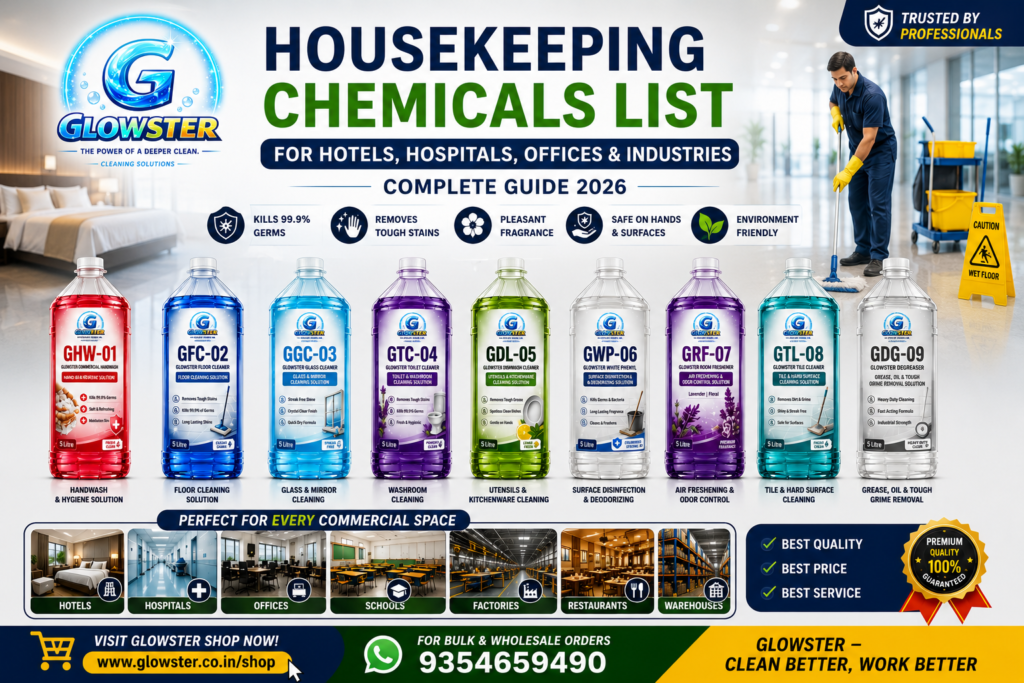
Glowster provides a commercial cleaning product range that includes:
- GHW-01 Commercial Handwash
- GFC-02 Floor Cleaner
- GGC-03 Glass Cleaner
- GTC-04 Washroom Cleaning Solution
- GDL-05 Dishwash Cleaner
- GWP-06 White Phenyl
- GRF-07 Room Freshener
- GTL-08 Tile Cleaner
- GDG-09 Degreaser
View the complete range of commercial cleaning products:
For washroom cleaning requirements, businesses can also explore:
Always follow the product label, recommended application method and safety instructions when using cleaning chemicals.
7. Inspect, Record and Improve the Schedule
Creating a cleaning schedule is only the first step.
Facility managers should regularly check:
- Were all scheduled tasks completed?
- Were high-traffic areas cleaned at the required frequency?
- Were cleaning chemicals used correctly?
- Were washrooms inspected?
- Were cleaning supplies available?
- Were any areas repeatedly missed?
- Does any area require more frequent cleaning?
- Are housekeeping staff following the SOP?
- Is additional staff training required?
For healthcare facilities, environmental cleaning programs require defined responsibilities, training, supplies, policies, monitoring and feedback.
Healthcare facilities should follow their specific infection prevention and control procedures and applicable regulations rather than relying on a generic commercial checklist.
WHO also provides guidance on environmental cleaning and infection prevention in healthcare facilities.
Daily, Weekly and Monthly Cleaning Schedule Example
Here is a simple Commercial Cleaning Schedule Tips template that can be adapted for offices, hotels, schools, factories, warehouses and other facilities.
Daily Cleaning Schedule
Morning Shift
- Entrance and reception cleaning
- Floor sweeping and mopping
- Washroom cleaning
- Handwash and hygiene supply check
- Waste collection
- High-touch surface cleaning
During Working Hours
- Washroom inspection
- Spill cleaning
- Waste removal
- High-traffic area maintenance
- Pantry and common-area cleaning
Evening Shift
- Complete floor cleaning
- Workstation and common-area cleaning
- Washroom cleaning
- Waste removal
- Final housekeeping inspection
Weekly Cleaning Schedule
- Detailed glass cleaning
- Deep floor cleaning
- Door and frame cleaning
- Storage-area cleaning
- Detailed pantry cleaning
- High-level dusting
- Equipment inspection
- Chemical stock review
Monthly Cleaning Schedule
- Deep cleaning of selected areas
- Difficult-to-reach surface cleaning
- Detailed storage-area cleaning
- Equipment maintenance review
- Cleaning chemical inventory audit
- Housekeeping performance review
- Cleaning checklist and SOP review
Commercial Cleaning Schedule for Different Facilities
Office Cleaning Schedule
Offices normally require regular cleaning of:
- Workstations
- Reception
- Meeting rooms
- Washrooms
- Pantry
- Floors
- Glass partitions
- Corridors
- Common areas
A proper office cleaning schedule should consider employee footfall, working hours, meeting-room usage and washroom traffic.
For additional office cleaning guidance:
Hotel Cleaning Schedule
Hotels generally require multiple cleaning frequencies because guest rooms, public areas, restaurants and washrooms have different usage levels.
A hotel housekeeping cleaning schedule may include:
- Guest rooms
- Lobby
- Corridors
- Public washrooms
- Restaurant areas
- Kitchen areas
- Glass and mirrors
- Staff areas
- Back-of-house areas
Cleaning frequency should be aligned with occupancy, traffic and hotel SOPs.
Hospital Cleaning Schedule
Hospitals require a more controlled environmental cleaning program because different patient-care areas have different risk levels.
A hospital cleaning schedule may include:
- Patient rooms
- Corridors
- Examination areas
- Waiting areas
- Toilets
- High-touch surfaces
- Procedure areas
- Appropriate non-critical equipment surfaces
Healthcare facilities should use facility-specific environmental cleaning procedures, infection prevention protocols and applicable regulations.
School Cleaning Schedule
Schools should divide cleaning into daily, weekly and monthly activities. Commercial Cleaning Schedule Tips
Daily:
- Classrooms
- Washrooms
- Corridors
- Common areas
- Drinking and wash areas
- Waste collection
Weekly:
- Detailed furniture cleaning
- Glass and doors
- Storage areas
- Difficult-to-reach areas
Monthly:
- Deep cleaning
- Detailed inspection
- Cleaning equipment review
- Hygiene supply inventory
Factory and Warehouse Cleaning Schedule
Factories and warehouses often require additional attention to:
- Production floors
- Loading areas
- Machine surroundings
- Oil and grease accumulation
- Storage areas
- Staff washrooms
- Break rooms
- Offices
- High-traffic routes
Industrial cleaning frequency should be based on dust generation, production activity, spills, traffic and the type of contamination present.
Read our detailed factory and warehouse cleaning guide: Commercial Cleaning Schedule Tips
Commercial Cleaning Checklist vs Commercial Cleaning Schedule Tips
These two terms are related but slightly different.
Commercial Cleaning Checklist
A checklist tells the cleaning employee which tasks need to be completed.
Example:
☐ Sweep floor
☐ Mop floor
☐ Clean washroom
☐ Empty dustbin
☐ Clean glass
☐ Refill handwash
Commercial Cleaning Schedule Tips
A schedule adds when the task should be performed and who is responsible.
Example:
Washroom → Clean → 3 times daily → Housekeeping Team → Supervisor Inspection
Using both together provides better operational control. Commercial Cleaning Schedule Tips
How to Reduce Cleaning Costs Without Reducing Cleaning Standards
A professional cleaning schedule can help businesses control cleaning costs through better planning.
Consider these practices:
- Purchase commonly used cleaning products in suitable bulk quantities.
- Track chemical consumption.
- Follow product label directions and recommended dilution where applicable.
- Avoid unnecessary repeated cleaning.
- Prioritize high-traffic areas.
- Maintain cleaning equipment properly.
- Train housekeeping staff.
- Keep a chemical inventory.
- Monitor wastage.
- Review the cleaning schedule regularly.
Businesses comparing concentrated and ready-to-use cleaning chemicals can also read:
Cleaning Chemicals and Safety
Cleaning chemicals should always be handled according to the manufacturer’s label, Safety Data Sheet where applicable, facility SOPs and relevant regulations.
Important practices include:
- Do not mix cleaning chemicals unless the product instructions specifically permit it.
- Use appropriate PPE.
- Store chemicals safely.
- Keep chemical containers properly labelled.
- Provide staff training.
- Ensure suitable ventilation where required.
- Follow manufacturer’s dilution and application instructions.
Commercial Cleaning Schedule Tips
The CDC advises against mixing cleaning and disinfecting products because doing so can create hazardous chemical reactions.
CDC Cleaning and Disinfection Guidance:
https://www.cdc.gov/hygiene/about/when-and-how-to-clean-and-disinfect-a-facility.html
Why Businesses Need a Professional Housekeeping Cleaning Schedule
A professional housekeeping cleaning schedule creates a repeatable system rather than relying on individual employees to remember every task.
Commercial Cleaning Schedule Tips
It can help facility managers:
- Standardize cleaning procedures
- Assign responsibilities
- Track completed work
- Monitor high-traffic areas
- Manage cleaning supplies
- Improve housekeeping supervision
- Identify recurring cleaning problems
- Maintain consistent facility standards
For businesses operating across multiple departments or shifts, documented checklists and inspection records can make facility management easier. Commercial Cleaning Schedule Tips
Glowster – Commercial Cleaning Products for Businesses
Glowster provides commercial cleaning and hygiene products for offices, hospitals, hotels, schools, factories, warehouses, restaurants and other commercial facilities.
Glowster is your trusted cleaning products supplier in Greater Noida. We provide high-quality housekeeping supplies and cleaning chemicals at wholesale rates. Contact us for all your cleaning product needs.
Glowster offers a range of commercial cleaning solutions designed for different business cleaning requirements.
Businesses looking for commercial cleaning products in Greater Noida, Noida and Delhi NCR can explore Glowster’s product range for regular B2B cleaning requirements.
Visit: Commercial Cleaning Schedule Tips
You can also learn more about Glowster:
Conclusion
A well-designed Commercial Cleaning Schedule Tips helps businesses turn cleaning from an irregular task into a structured facility-management process.
The most effective approach is to divide the facility into zones, create daily, weekly and monthly cleaning checklists, assign responsibilities, select appropriate cleaning products, train staff and regularly inspect completed work.
Whether you manage an office, hotel, hospital, school, factory, warehouse or restaurant, your cleaning schedule should be based on traffic, surface type, operational requirements and facility-specific hygiene standards.
A cleaner workplace starts with a clear plan — and a professional cleaning schedule makes that plan easier to execute and monitor.
Commercial Cleaning Schedule Tips
Frequently Asked Questions
What is a commercial cleaning schedule?
A commercial cleaning schedule is a planned system that defines cleaning tasks, frequency, responsible staff, cleaning methods and inspection requirements for a commercial facility. Commercial Cleaning Schedule Tips
How often should a commercial facility be cleaned?
Cleaning frequency depends on the type of facility, traffic, surface type, contamination risk and operational requirements. High-touch and high-traffic areas generally require more frequent attention. Commercial Cleaning Schedule Tips